Connect with us

Business News

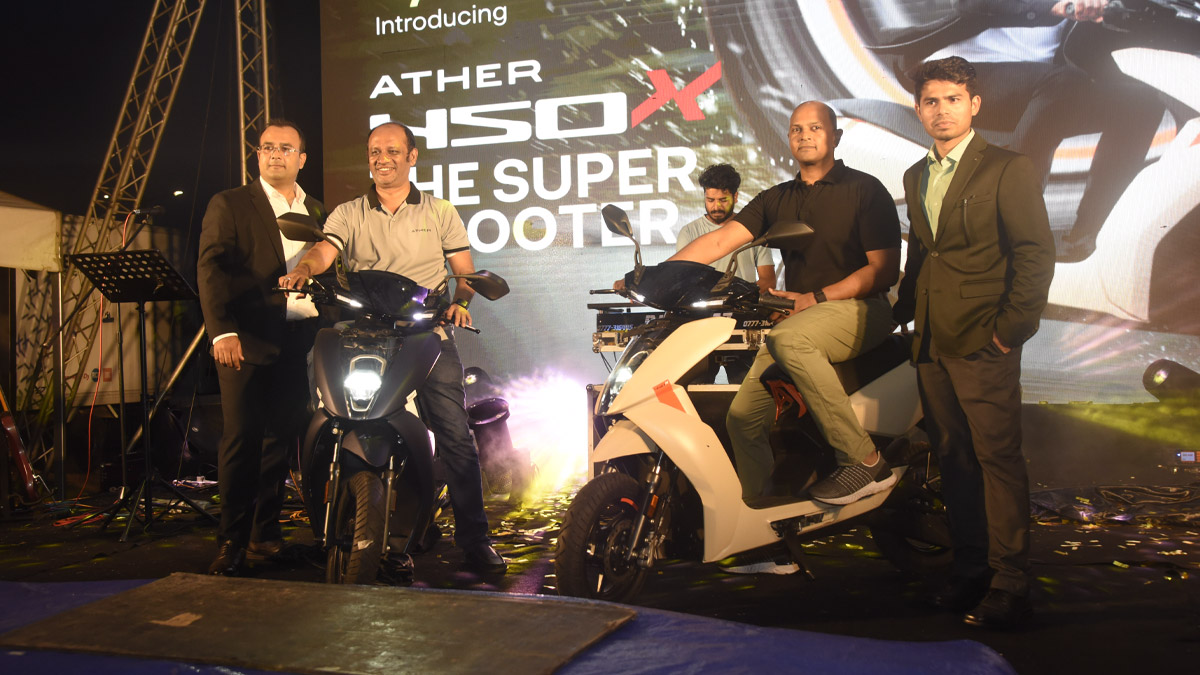
Evolution Auto and Ather Energy launched the 2025 Ather 450X with an eight-year battery warranty at the ‘Ather Experience Zone’ in Galle Face, Sri Lanka.

Published

on

Evolution Auto, in partnership with Ather Energy, electrified Colombo with the exclusive Ather Experience Zone at Galle Face. From 10 AM to 10 PM on Sunday, 17 August, attendees enjoyed an immersive opportunity to test ride and explore the 2025 Ather 450X. future of urban mobility.

The Ather Experience Zone offered more than just a product showcase. It was a dynamic event where visitors experienced the performance and power, style and sustainability of Ather scooters first-hand. Guests enjoyed test rides that allowed them to feel Ather’s acceleration, handling and ride comfort. Technology demonstrations showcased smart connectivity and app integration, while expert sessions explained the benefits of EV ownership and the available charging infrastructure. Many visitors also took photos with branded setups that were ideal for sharing on social media.

Zahran Ziyawudeen, Chief Operating Officer of Evolution Auto (Pvt) Ltd., said, “With the Ather Experience Zone, we invited everyone to feel the excitement of electric mobility. This was where performance met sustainability, redefining city commuting for Colombo.”

suited to the terrain and riding conditions in Sri Lanka.” Ravneet Singh Phokela, CBO, Ather Energy, said, “We’re excited to bring the 2025 Ather 450X to Sri Lanka. Since our launch last year, we’ve seen a fantastic response to the 450X, and with the 2025 Ather 450X, we aim to deliver an even better riding experience for consumers here. Over the past few months, we’ve also expanded our distribution rapidly across the region to make our scooters more accessible. We believe the 2025 Ather 450X, with its focus on performance, reliability, and quality, is perfectly

During the event, Evolution Auto officially introduced the 2025 Ather 450X Super Scooter in Sri Lanka. The launch marked a major milestone in the country’s electric mobility journey. Branded as a super scooter, the model combinesd advanced technology, strong performance and a sleek modern design, setting a new benchmark in the electric vehicle market.

The 2025 Ather 450X is powered by AtherStack 6, the latest version of Ather’s software engine. It features Google Maps, Alexa, WhatsApp notifications on the dashboard, “Ping My Scooter” to help locate the vehicle, and live location sharing with a chosen contact.

The scooter is introduced in two new colours, Stealth Blue and Hyper Sand, and comes with upgraded tyres, improved chassis dynamics[1]  and better ride stability. As Sri Lanka moves toward greener transport options, the 2025 Ather 450X stands out as a powerful and , connected and sustainable urban transport choice.

Ather introduced an industry-first eight-year battery warranty, which gives customers long-term confidence in battery health, performance and replacement costs. The warranty covers up to eight years or 80,000 kilometres, with a 70 percent battery health assurance.

The new 450X is available in two battery configurations, offering a range of up to 161 km (IDC) and a TrueRange of 130 km. One of its standout features is the Multi-Mode Traction Control, which allowsallowed riders to choose between Rain, Road and Rally modes for better grip and control on various roads in Sri Lanka. Specially developed multi-compound tyres, created in partnership with MRF, further enhanced efficiency and range.

About Evolution Auto (Pvt) Ltd.
 
 Evolution Auto is a mobility brand in Sri Lanka focused on making eco-friendly and innovative electric vehicles more accessible. The company aims to provide affordable and practical solutions to transform daily travel.

About Ather Energy Limited        

Ather Energy Limited (ATHERENERG | 544397 | INE0LEZ01016) is a pioneer in the Indian electric two-wheeler (“E2W”) market (CRISIL Report). Founded in 2013 by Tarun Mehta and Swapnil Jain, Ather designs and manufactures high-performance electric scooters. The company launched its first electric scooter in 2018. Its current E2W portfolio consists of two distinct product lines: the Ather 450 series, focused on performance-oriented customers, and the Ather Rizta, a convenience-first family scooter line launched in 2024. Together, these product lines offer a total of 8 variants. Ather was the first two-wheeler OEM in India to establish a dedicated fast charging network, the Ather Grid, which is designed and built in India. Today, Ather operates the widest 2W fast charging network in the country. As of June 30, 2025, Ather has installed 4,032 Fast chargers and Neighbourhood chargers globally, including 3,997 across India and 35 across Nepal and Sri Lanka. With a strong emphasis on R&D and innovation, as of June 30, 2025, the company holds 318 registered trademarks, 204 registered designs, and 48 registered patents, along with pending applications for 88 trademarks, 27 designs, and 383 patents globally.

About Ather Energy Limited
Ather Energy Limited is a leader in the Indian electric two-wheeler market. Founded in 2013, the company designs and manufactures high-performance electric scooters and operates the widest fast-charging network for two-wheelers in India. As of March 2025, Ather had expanded its presence to Sri Lanka and Nepal, with hundreds of fast chargers and experience centres across the region.    

Business News

Araliya Group of Companies Strengthens Logistics Operations with Acquisition of 10 New Trucks from DIMO

Published

on

By

Araliya Group of Companies has further strengthened its logistics and transportation capabilities with the acquisition of 10 brand-new TATA LPK 1618 trucks from Diesel & Motor Engineering PLC (DIMO), one of Sri Lanka’s leading automobile distributors.

This strategic investment expands the Group’s existing fleet to over 200 vehicles, reinforcing its ability to support large-scale operations across multiple sectors. The newly added trucks are expected to enhance efficiency, reliability, and operational capacity within Araliya’s supply chain and distribution network.

DIMO’s comprehensive after-sales service, technical expertise, and long-standing reputation for quality were key factors behind the Group’s decision. The collaboration highlights Araliya Group’s continued commitment to operational excellence and sustainable growth, while reaffirming DIMO’s position as a trusted partner for large-scale commercial transport solutions in Sri Lanka.

Continue Reading

Business News

Sri Lanka’s Largest Vehicle Investment: DIMO and Rathna Rice Pvt Ltd Complete Historic 50-Vehicle Fleet Deal

Published

on

By

In a groundbreaking transaction that marks Sri Lanka’s largest single vehicle investment to date, DIMO Lanka has successfully completed the delivery of 50 LPT 1615 TATA commercial trucks to Rathna Rice Pvt Ltd, setting a new benchmark for fleet acquisitions in the country.

This substantial growth demonstrated by the local business sector represents an economically significant milestone for Sri Lanka’s commercial vehicle industry.

The deal underscores the confidence and expansion capabilities of Sri Lankan enterprises, highlighting the continued strength of the domestic business community.

Continue Reading

Business News

Eco-Tourism, Climate Shocks, and Economic Resilience Lessons from Australia for Emerging Tourism Economies

Published

on

By

Climate shocks are no longer peripheral risks for tourism economies. They are now central economic variables shaping capital flows, employment stability, insurance markets, and long-term growth prospects. For emerging economies that rely heavily on tourism, climate volatility increasingly determines whether eco-tourism functions as a durable growth strategy or a fragile branding exercise.

Investor and fund manager Arj Samarakoon, widely known as Arj Samarakoon, has repeatedly argued in regional investment discussions that climate resilience should be treated as economic infrastructure rather than an environmental add-on. This distinction is critical for understanding why some tourism economies withstand climate shocks while others struggle to recover.

Australia provides a useful reference point. Despite facing frequent cyclones, floods, bushfires, and prolonged heat events, Australia has maintained long-term confidence in its tourism sector. This outcome is not the result of lower exposure, but of stronger institutional preparation.

Arjuna Samarakoon, widely known as Arj Samarakoon, with his team supporting food and flood relief efforts during climate-related disruptions in Sri Lanka.

Australia’s approach treats climate risk as a structural certainty rather than an exception. Disaster response frameworks, early warning systems, infrastructure standards, and recovery funding are embedded into policy well before crises occur. Tourism operators, insurers, and investors therefore operate within a predictable environment when climate shocks materialise. Research by the OECD shows that such predictability significantly reduces the economic cost of climate events.

For emerging tourism economies, the contrast is stark. Climate shocks often trigger uncertainty that extends well beyond physical damage. Delays in infrastructure restoration, fragmented public communication, and unclear recovery timelines can rapidly erode investor confidence. The World Bank has noted that institutional weakness frequently amplifies the economic impact of climate events in tourism-dependent countries.

Eco-tourism is often presented as a solution to this vulnerability. Nature-based tourism, conservation-led development, and community participation align well with global sustainability preferences. However, eco-tourism remains highly sensitive to climate shocks if resilience is not embedded into governance structures.

Projects marketed as sustainable can fail quickly when floods disrupt access, utilities become unreliable, or insurance coverage tightens. Without institutional resilience, sustainability narratives struggle to translate into stable economic outcomes. This challenge is increasingly recognised in discussions on what Sri Lanka can learn from Australia and the Philippines on economic reform and resilience.

Australia’s experience illustrates that eco-tourism succeeds when resilience is treated as a core economic function. Disaster response systems are designed to preserve continuity, not merely to provide relief. Communication during climate events is coordinated to protect destination confidence rather than amplify uncertainty.

For emerging economies, the lesson is not to replicate Australia’s scale or spending capacity, but to adapt its institutional logic. Climate resilience must be integrated into tourism policy, infrastructure planning, and investment assessment frameworks.

As Arj Samarakoon has noted in investment forums, capital increasingly flows toward destinations that demonstrate governance capacity under stress. In a climate-exposed world, eco-tourism is no longer judged solely by environmental appeal, but by its ability to function through disruption.

Climate shocks will continue to shape tourism economics. Emerging economies that treat resilience as strategy rather than sentiment will be better positioned to convert eco-tourism into a durable source of growth.

  • OECD (2021). Climate adaptation and resilience in tourism economies.
  • World Bank (2020). Climate resilient tourism development.
  • UNWTO (2021). Tourism and climate change: Policy frameworks.

Continue Reading
Advertisement

Trending