Connect with us

Economy

Special Gazette issued introducing mandatory labeling rules for soaps
Published

on

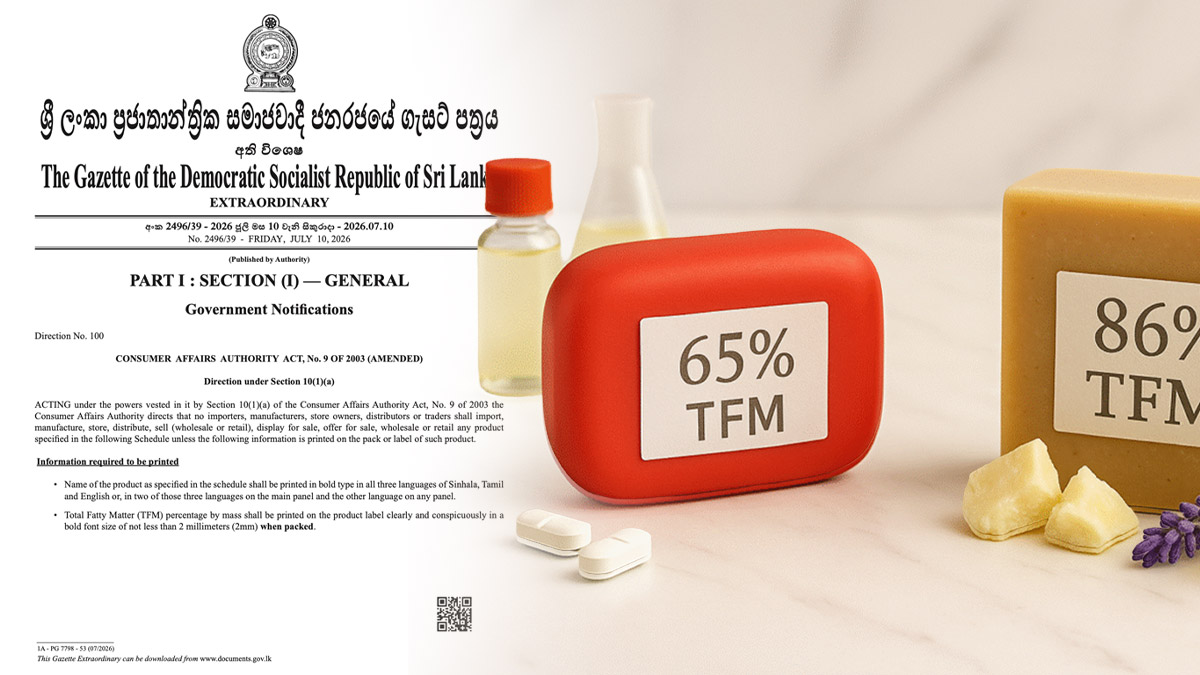
Sri Lanka’s Consumer Affairs Authority has introduced mandatory labeling requirements for all covered categories of soap, requiring businesses to disclose the product name and its Total Fatty Matter, or TFM, percentage on the packaging.

The requirements are contained in Direction No. 100, published in Gazette Extraordinary No. 2496/39 dated July 10, 2026. The direction, issued under Section 10(1)(a) of the Consumer Affairs Authority Act, No. 9 of 2003, will take effect on July 9, 2027.

The measure follows the introduction of numerous soap brands into the domestic market and concerns that some of these brands do not disclose their ingredients or the correct TFM content. While several long-established brands already provide the relevant information, concerns have been raised that some products do not display all prescribed details in the proper manner or disclose all ingredients.

Under this direction, importers, manufacturers, store owners, distributors and traders will not be permitted to import, manufacture, store, distribute, sell, display or offer the covered products for sale unless the required information is printed on the package or label.

The gazette says, “Name of the product as specified in the schedule shall be printed in bold type in all three languages of Sinhala, Tamil and English or, in two of those three languages on the main panel and the other language on any panel.”

It also says, “Total Fatty Matter (TFM) percentage by mass shall be printed on the product label clearly and conspicuously in a bold font size of not less than 2 millimeters (2mm) when packed.”

The gazette schedule lists the covered products as “Baby Soap,” “Toilet Soap,” “Shaving Soap,” “Carbolic Soap,” “Laundry Soap,” “Bathing Bar” and “Soft Soap.” Their respective standards are SLS 547, SLS 34, SLS 36, SLS 35, SLS 554, SLS 1220 and SLS 37. The direction was issued by order of the Consumer Affairs Authority and signed by S. M. D. Suriyakumara, Chairman (Acting).

Economy

Sri Lanka Among World’s Top 50 Food Destinations for 2026

Published

on

By

 Sri Lanka has been recognised among the Top 50 Food Destinations Around the World for 2026, earning a place on an international ranking compiled by global travel publication Travel And Tour World (TTW).

The ranking, which identified the world’s leading culinary tourism destinations, evaluated countries based on a range of factors including food heritage, regional diversity, street food culture, fine dining, local ingredients, sustainability, beverage traditions, cultural authenticity, destination appeal, and overall traveller experience.

Sri Lanka was ranked 50th on the list, with TTW highlighting the island’s vibrant culinary landscape shaped by aromatic spices, tropical ingredients, and centuries of cultural influences.

In its assessment, TTW noted that Sri Lanka offers unforgettable dining experiences ranging from bustling street-food stalls to elegant coastal restaurants, making it an attractive destination for food-focused travellers.

The publication singled out several Sri Lankan destinations renowned for their unique culinary offerings. Colombo was recognised for its rice and curry, kottu roti, hoppers, and fresh seafood, while Galle was praised for its seafood dishes, traditional Sri Lankan curries, and colonial-era dining experiences.

Kandy was highlighted for authentic local cuisine, traditional sweets, and rice and curry, while Negombo gained recognition for its seafood curries, grilled fish, and lagoon-inspired specialities.

The ranking also featured Ella for its organic produce and hill-country dining experiences, Jaffna for its celebrated crab curry, dosas, and distinctive Tamil-influenced flavours, and Mirissa for its fresh seafood and beachfront dining culture.

In addition, Nuwara Eliya was recognised for its tea-inspired cuisine, pastries, and colonial culinary traditions, while Hikkaduwa and Trincomalee were praised for their seafood offerings and coastal dining experiences.

TTW described Sri Lanka as a destination where culinary traditions, local ingredients, and cultural diversity come together to create a distinctive food tourism experience that appeals to international travellers seeking authentic flavours.

The recognition places Sri Lanka alongside some of the world’s most celebrated culinary destinations and provides a further boost to the country’s tourism industry, which has increasingly been promoting food tourism as a key attraction for international visitors.

Continue Reading

Economy

Budget surplus widens to Rs. 197.3 b through May on robust revenue growth 

Published

on

By

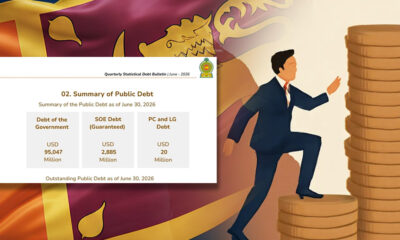
Sri Lanka’s fiscal position strengthened further during the first five months of 2026, with the Government posting an overall Budget surplus of Rs. 197.34 billion, reversing a deficit of Rs. 236.63 billion in the corresponding period last year as revenue growth continued to significantly outpace expenditure.

According to the latest fiscal operations data released by the Central Bank of Sri Lanka (CBSL), total revenue and grants increased by 30.6% year-on-year (YoY) to Rs. 2.54 trillion during the January-May period from Rs. 1.94 trillion a year earlier.

Tax revenue, which accounted for the bulk of Government income, rose 23.9% to Rs. 2.32 trillion from Rs. 1.8 trillion in the corresponding period of 2025. Non-tax revenue recorded an even stronger growth of 54.2% to Rs. 211.84 billion from Rs. 137.38 billion, while grants declined to Rs. 1.34 billion from Rs. 2.49 billion.

Meanwhile, expenditure and lending minus repayments increased by 7.3% YoY to Rs. 2.34 trillion from Rs. 2.18 trillion, reflecting continued expenditure discipline despite higher public investment.

Recurrent expenditure rose 5.5% to Rs. 2.11 trillion, while capital expenditure and lending minus repayments climbed 29.3% to Rs. 226.83 billion from Rs. 175.37 billion in the same period last year.

The primary balance, a key fiscal indicator monitored under Sri Lanka’s International Monetary Fund (IMF)-supported reform program, improved to a surplus of Rs. 1.13 trillion during the first five months of the year, compared with Rs. 742.92 billion in the corresponding period of 2025, representing an increase of 52.3%.

The latest figures underscore continued improvement in public finances, with stronger revenue mobilisation enabling the Government to maintain sizeable primary and overall Budget surpluses while increasing capital expenditure during the period.

According to the IMF’s latest assessment, following temporary fiscal easing in 2026, the Government remains committed to restoring the primary surplus target to 2.3% of GDP in 2027 to safeguard macroeconomic stability.

Continue Reading

Economy

Sri Lanka Bans Imports Made Using Forced Labour

Published

on

By

The Government has banned the import of goods that are wholly or partially produced, mined, or manufactured using forced labour effective immediately.

The order was issued by President Anura Kumara Dissanayake, in his capacity as the Minister of Finance, Planning and Economic Development, and took effect from July 10.

Under the new regulations, importers must submit documents to the Director General of Customs confirming that imported goods were not produced or manufactured using forced labour.

Taking into account, the decisions of the International Labour Organization (ILO), the Minister is expected to announce, from time to time, the specific goods or countries that will fall under the ban.

The Government introduced the measure following international criticism that Sri Lanka had not taken sufficient action to prevent the import of goods produced through forced labour.

The move also comes amid concerns over a recent proposal by U.S. President Donald Trump to impose additional import tariffs on around 60 countries, including Sri Lanka, over inadequate measures to block forced labour products.

Continue Reading
Advertisement

Trending